Units on technical drawings — what ISO 129-1, ISO 21920 and ISO 80000 actually require
More relevant than it seems
"Do I have to state mm on the drawing?" — the question comes up surprisingly often. And indeed, the current ISO GPS landscape has changed things here. Earlier standards still prescribed the note on millimetres explicitly; in the current editions it is regulated implicitly, through ISO 129-1 and the ISO 80000 series.
The following sections show when and where units must appear on technical drawings, how that follows from the standards, and what makes sense in practice.
Dimensions and units in the ISO world
The basis is ISO 80000-1:2022 "Quantities and units — Part 1: General", which describes the International System of Units (SI). It defines:
The base unit of length is the metre (m).
All technical dimensions in the SI system derive from it — including the millimetre (mm), which is used almost exclusively in technical drawing practice.
So with "mm", ISO 129-1 implements what ISO 80000 prescribes.
What ISO 129-1 actually says
The current edition states in clause 4.3 "Units":
For linear units, the predominant unit may be indicated on the drawing itself or in an accompanying document, and may then be omitted from the individual dimensions.
For angular dimensions, the units shall always be indicated with the individual dimensions...
All dimensions given in a different unit of measurement shall indicate that unit.
In summary:
- For linear dimensions, a predominant unit (e.g. mm) may be stated once in the title block — it then does not have to appear next to every dimension.
- Angular dimensions must always carry a unit (°, ′, ″).
- All other physical quantities (e.g. N·m, µm, s, °C) must be stated with their unit directly.
The earlier sentence "Unless otherwise specified, linear dimensions are given in millimetres", part of the standard up to the 2004 edition, no longer exists.
The default unit for surface texture callouts under ISO 21920
The new ISO 21920-1 … -3:2021 series (replacing ISO 1302, 4287 and 4288) also regulates the units for surface texture parameters.
| Parameter | Default unit | Source |
|---|---|---|
| Ra, Rz, Rt, Rp, Rv, Rq … | µm (micrometre) | ISO 21920-3:2021 § 4.4.3 |
| Sa, Sq, Sz … (areal) | µm (micrometre) | ISO 25178-2:2021 |
That means:
- If a surface texture callout states no unit with the parameter, µm applies automatically.
Practical examples under ISO 129-1
| Indication | Correct? | Reason |
|---|---|---|
| 25 | ✓ | mm applies implicitly as the predominant unit, but must be stated globally in the title block |
| 45° | ✓ | Angles must always carry a unit |
| Ø10 mm | ✓ | The unit may be stated voluntarily |
| Ra 0.8 | ✓ | Default unit is µm under ISO 21920 |
| A = 250 mm² M = 20 N·m | ✓ | Units that differ from the global value in the title block must be stated explicitly |
How ISO 80000 and ISO 129-1 connect
The ISO GPS family of standards is built on the ISO 80000 series. ISO 129-1 no longer defines the unit itself but implicitly refers to the SI system:
ISO 80000-1 § 6.2 — base unit of length: metre (m)
→ Sub-unit: 1 mm = 10⁻³ m
→ May be indicated on drawings as the "predominant unit" (ISO 129-1 § 4.3)
The millimetre (mm) is thus an officially derived SI unit for technical product documentation.
Recommendation for practice
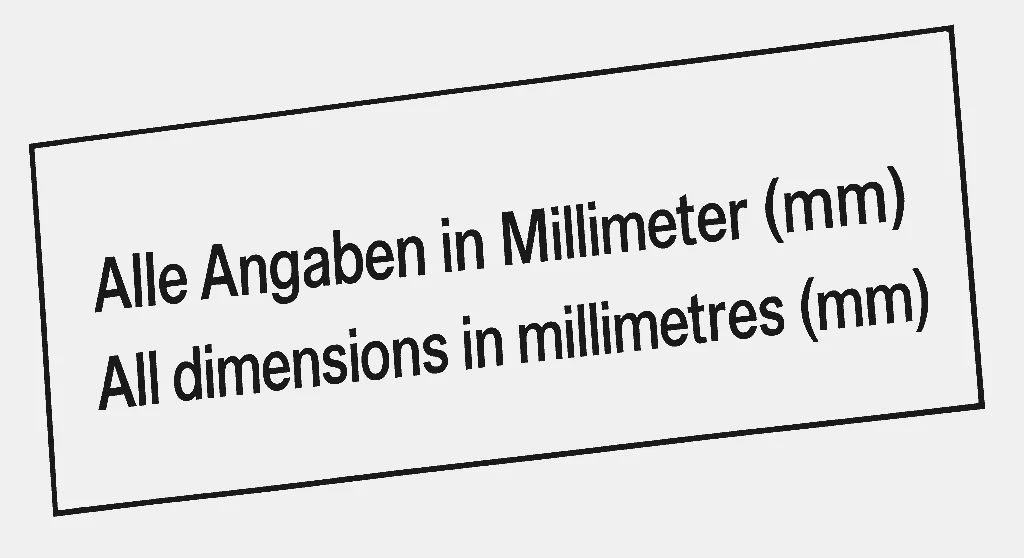
In the title block or in the legend:
This line conforms to the standards, is internationally understood and secures unambiguous interpretation — especially in global data exchange (STEP, DXF, PDF, QIF and so on).
Note the spelling in English:
✓ British English (ISO-conform): → millimetres (mm)
US American English: → millimeters (mm)
Since ISO standards are written in British English, the official form is:
All dimensions in millimetres (mm)
If you work to ISO 129-1 or ISO 8015, the spelling ending in "-res" is the correct one.
Conclusion
Millimetres are common practice, but no standard lists them as the default — so they must be defined by a note in or above the title block.
| Topic | Basis in the standards | Rule |
|---|---|---|
| Linear dimensions | ISO 129-1 § 4.3 + ISO 80000-1 § 6.2 | The unit may be stated globally, e.g. "mm" |
| Angular dimensions | ISO 129-1 § 4.3 | Unit (°, rad, gon) always with the dimension |
| Other physical quantities | ISO 129-1 § 4.3 | Unit always with the value |
| Roughness parameters | ISO 21920-3 § 4.4.3 | Default = µm |
| Deviating units | ISO 129-1 § 4.3 | Always state explicitly |
In one sentence: on technical drawings the millimetre counts as an implicit, derived SI unit, based on ISO 80000-1 and ISO 129-1. It does not have to appear next to every dimension as long as the title block or the document states: "All dimensions in millimetres (mm)". Whether your drawing is unambiguous in every other respect is what our ISO GPS drawing review clarifies.
By the way
In text such as reports, but also in drawing notes, ISO 80000-1 requires a space between value and unit — this is often done wrong. Correct: 10 mm, 20 bar and 15 °C. Wrong: 10mm, 20bar and 15°C.
The exception is units that are not physical but express fractions, such as percent (/100) and all angles (/360 for degrees). Correct: 95% and 115°. Wrong: 95 % and 115 °.
Sources
ISO 21920-1 … -3:2021 — Surface texture: Profile
ISO 80000-1:2022 — Quantities and units — Part 1: General